
One of the most distinctive features of Pencak Silat in general, and in some styles in particular, is mastery of the low level (bawah). It is not just a matter of adopting low positions for aesthetic purposes, but rather a complete body workout with physical, technical, strategic and cultural implications.
For many practitioners, especially those who come to Silat from other martial arts or from a body unaccustomed to this type of demand, the bawah level is one of the greatest challenges in learning. Understanding it, adapting it to one’s own body and applying it meaningfully requires time, patience and a very specific training approach.
One of the most common mistakes is to think that the bawah level simply consists of lowering the body further. In reality, the low level involves a reorganisation of the body’s structure, the body must learn to move where it has never been before. The centre of gravity descends, but the distribution of weight, the use of the joints and the relationship with the ground also change.
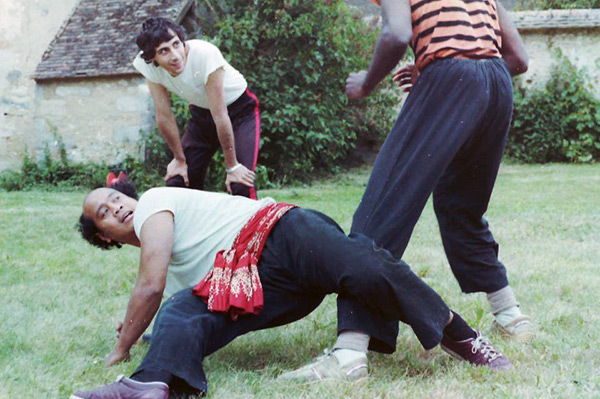
The bawah level is demanding on the body, especially on the joints. The knees work in deep flexions, the hips must combine mobility and stability in wide ranges, the ankles need to regain dorsiflexion, the shoulders must increase their load capacity, and the lower back must learn to maintain posture without collapsing.
For an unadapted body, these demands are quickly felt. That is why it is important to understand that the bawah level requires time, needs to be built up calmly, with knowledge and progressive practice, improving mobility before going deeper and prioritising the quality of the position or movement. Trying to force low postures without adequate preparation only leads to compensations, discomfort and injuries. The goal is not to get as low as possible, but to be able to stay low with control, without unnecessary tension and with the ability to move.
When you start working on the bawah level, results take time to appear. Your legs tire quickly, as do your arms, your joints ache, you tremble, and your breathing takes a back seat. This is normal, it’s part of the process. Over time, your body adapts, you gain strength, your joints gain range of motion and your body learns to relax.
There are no shortcuts, only consistency and controlled progression.
Once the body has adapted, we can see the benefit of being there in combat. From low positions, the angles of attack change and the opponent loses their usual references. You have control of their base, their balance and their legs, while reducing their options for direct attack.
In Silat, combat is not interrupted when you go to the ground, it simply changes planes.
Positions such as Depok kuda, Harimau kuda, Sempok kuda, Ular Kuda, Naga Kuda, Satu Kuda or even Machan Kuda are the masters of the bawah level, extremely deceptive, which benefits us once we have them under control.
Mastery of the bawah level does not mean staying down constantly, but being able to change levels smoothly, going up and down, holding your position, going back up and using those changes as a resource.
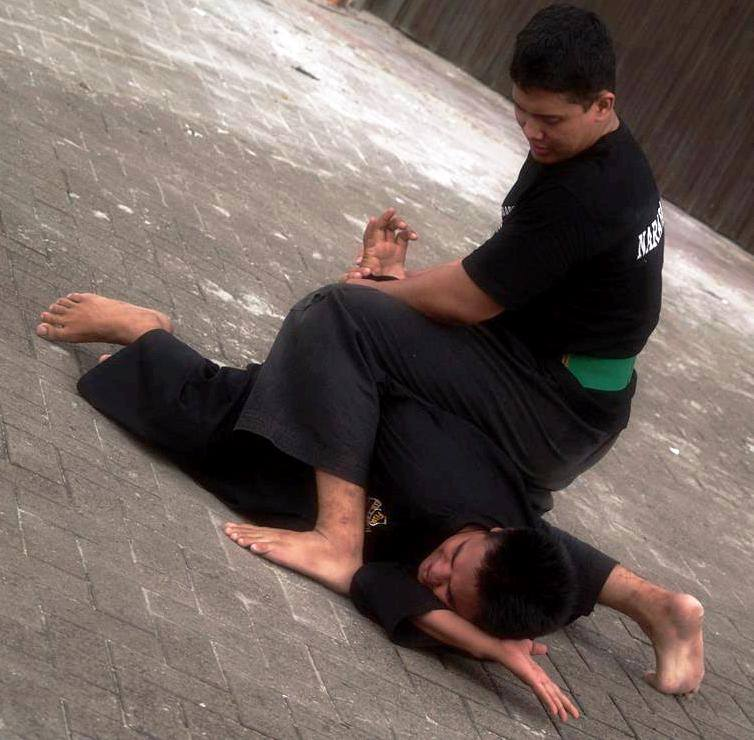
For many pesilats, even after years of practice, the bawah level is that uncomfortable zone where you have no control, and some try to avoid it. It is complicated, it is constant work over many years.
Bawah is not an aesthetic requirement or a meaningless added difficulty. It is a fundamental technical tool and a path to long-term development. Those who learn to work correctly at the bawah level not only improve their Silat, but also their way of moving and understanding their own body in combat.
– Xabier –